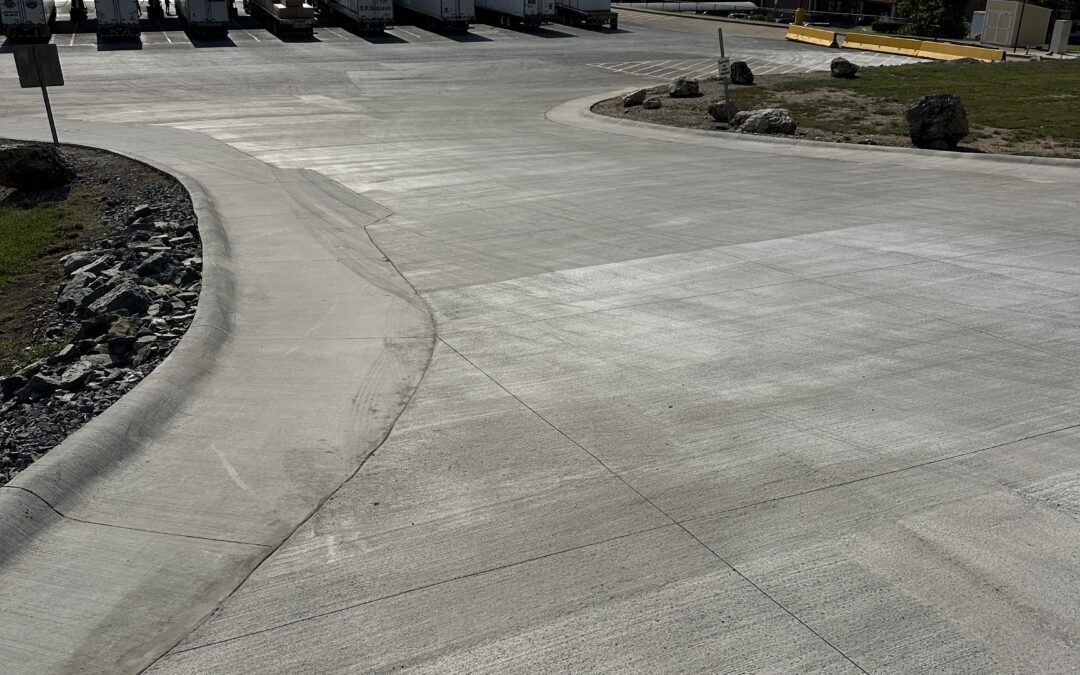
When you’re managing a commercial property like a truck stop, travel center, or high-volume restaurant, your pavement isn’t just a surface, it’s a crucial part of your operation. From constant semi-truck traffic at brands like Love’s Travel Stop & Country Stores to high-turnover parking at restaurants like Texas Roadhouse, choosing the wrong pavement can lead to premature failure, safety issues, and costly repairs. Choosing the best paving strategy for commercial properties isn’t just about cost—it’s about performance, durability, and long-term ROI.
Most people assume a customer’s first interaction with their business starts at the front door, but that’s not actually the case. The real first impression happens much earlier, the moment they turn into your property and drive across your pavement.
Before they ever reach your entrance, customers are already forming opinions based on what they see and feel: the smoothness of the drive, the clarity of the striping, the condition of the surface, and how easy it is to navigate your lot. Cracks, potholes, fading lines, or uneven areas don’t just impact appearance, they signal neglect, create frustration, and can even raise safety concerns.
A real-life example of this is a Wendy’s in Spring Hill, Tennessee. For a long time, I avoided that location entirely, not because of the food or service, but because of the condition of the parking lot.
The pavement was in such poor shape that simply entering and exiting the property felt like a risk. Between potholes, uneven areas, and general wear, it became more of an ordeal than a quick stop for a meal. I found myself choosing other locations just to avoid the hassle and potential damage to my vehicle.
They’ve since repaired the lot, and the difference is immediate. It’s easier to access, safer to navigate, and overall a much better experience. But it’s a clear example of how pavement condition alone can influence customer behavior.
Even when everything else about a business is right, a neglected parking lot can be enough to drive customers away before they ever walk through the door.
On the flip side, a well-maintained parking lot does more than look good, it creates a seamless, professional experience from the very start. It tells your customers that you care about quality, safety, and attention to detail before they even step out of their vehicle.
In high-traffic environments like truck stops and busy restaurants, this matters even more. Your pavement isn’t just part of your property, it’s the first touchpoint of your brand and a critical step in shaping the overall customer experience.
So, asphalt or concrete? Let’s break it down for real-world use.
Asphalt parking lots for commercial properties
Asphalt pavement is the most widely used solution for commercial parking lots, especially in retail centers, restaurants, and multi-tenant properties. Its affordability and quick turnaround make it a go-to choice for businesses that need efficient, scalable paving solutions.
Why asphalt works?
- Cost-effective for large areas like expensive parking lots
- Fast installation helps minimize business downtime
- Provides a smooth, comfortable ride for high customer turnover
- Easy to maintain and repair, including crack filling and restriping
Where it falls short
- Can struggle under constant heavy loads, such as semi-truck traffic
- More susceptible to rutting and softening in high heat, especially in Southern climates
- Requires ongoing maintenance, including sealcoating and crack sealing, to maximize lifespan
Best applications for asphalt
Asphalt is ideal for:
- Restaurant and quick-service locations
- Retail shopping centers
- Office complexes and multi-tenant properties
- General parking areas with light-to-moderate vehicle traffic
Concrete parking lots for heavy-duty commercial use
Concrete pavement is engineered for strength, durability, and long-term performance, making it the preferred choice for high-load, high-impact commercial areas. In environments where heavy vehicles are constantly stopping, turning, and idling, concrete delivers the structural integrity asphalt often cannot.
wHY CONCRETE WINS?
- Handles heavy truck traffic without rutting or deformation
- Offers a longer lifespan in high-stress environments
- Performs well in tight turning areas, such as fuel islands and drive thru lanes
Trade-offs
- Higher upfront investment compared to asphalt
- Requires longer curing time before it can be fully used
- Repairs can be more visible and costly if damage occurs
Best applications for concrete
Concrete is best suited for:
- Truck stops and travel centers
- Loading docks and delivery zones
- Dumpster pads and service areas
- Drive lanes, entrances, and fuel islands where heavy vehicles stop, turn, and idle
the real-world solution? you need both!
Here’s what successful commercial properties (including national brands) actually do:
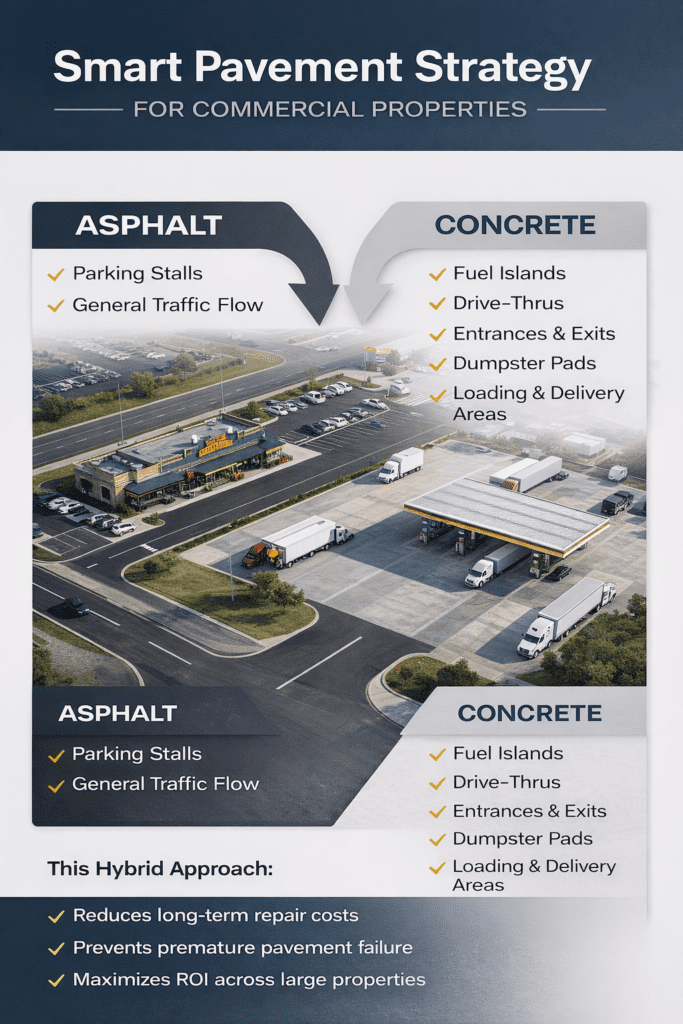
Smart pavement strategy for commercial properties
The most effective commercial properties don’t choose between asphalt or concrete, they strategically use both to maximize performance and longevity.
conclusion
Why this hybrid approach works?
By leveraging the strengths of both asphalt and concrete, property owners can significantly reduce long-term repair and maintenance costs while preventing premature failure in high-stress areas. This approach also enhances overall safety and durability across the entire property, all while maximizing ROI on large-scale paving investments.
It’s a proven strategy used by high-traffic commercial properties because it aligns pavement design with real-world traffic patterns and load demands—not a one-size-fits-all solution. By combining materials effectively, you can implement the best paving strategy for commercial properties based on real-world traffic and usage.
If you’re unsure how to apply this approach to your property, let our team evaluate your site and recommend the right solution for your needs. Give Mad Jack’s Asphalt & Concrete a call at (615) 480-0489 or request a free quote HERE.